January 27th, 2012
I bought a more relevant-sounding domain name for this site. From now on, please find us at www.readlikeanerd.com. The old URL will still work as a mirror, for now, but please update your bookmarks and RSS feed in case because I can’t promise it always will.
I’m going to leave this message on top for awhile, but I will continue to put up a review for each month. Expect February’s in a couple weeks!
Posted in Uncategorized | No Comments »
January 1st, 2012
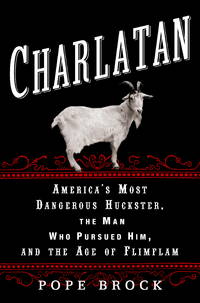
Charlatan: America’s Most Dangerous Huckster, the Man Who Pursued Him, and the Age of Flimflam by Pope Brock is an engaging historical tale about medical quackery from the early 20th century. I enjoyed the brief mention this story had received in Mary Roach’s Bonk, but it was great to read the whole tale.
The book follows one of America’s greatest con artists, John Brinkley, and his arch-nemesis Dr. Morris Fishbein. Fishbein, whose pet project was debunking medical quackery, worked tirelessly to expose Brinkley for what he was. The book is equally about Fishbein as it is about Brinkley, but the con artist’s tale really steals the show.
John Brinkley was a con-man from a poor background who purchased medical degrees and made his way around the country posing as a doctor selling ridiculous treatments to gullible people. He became famous for one procedure in particular: transplanting goat testicles into healthy adult men in an attempt to increase their virility. Despite having no medical training, minimal grasp on sanitation, and leaving a wake of sick, crippled and unhappy patients, Brinkley earned millions.
Brinkley was a true charlatan, charismatic and wildly popular. He was rich, famous and respected. He ran for political office several times, losing only narrowly to his opponents. When he was chased from state to state by medical licensing boards, Fishbein, and eventually the law, he set up shop in Mexico just south of the Texan border so he could broadcast his crazy medical ideas across the border without repercussion. His border blaster radio station remained hugely popular despite his controversial medical beliefs and brushes with the law, and made him somewhat of a pioneer in radio.
Eventually the hammer was brought down on Brinkley as he lost multiple lawsuits for his medical misadventures, depleting his millions and forcing him to declare bankruptcy. And in addition to his conviction of various medical frauds, he was also investigated for both tax fraud and mail fraud – a swindler in every sense of the word.
From a modern standpoint, Brinkley was such an absurd person with ideas that were so blatantly ridiculous that is almost difficult to grasp this as a non-fiction book. Yet even today, we can see the fervor for his cures still going strong in today’s popular “alternative medicine.”
The book is illuminating, fascinating, amusing and fast paced, and an all-around good read.
on Amazon.com Kindle
or in Paperback
.
Tags: alt med, alternative medicine, blaster radio, charlatan, con artist, goat testicles, impotence, John Brinkley, malpractice, medical quakery, Medical Question Box, Mexican border blaster, Morris Fishbein, Pope Brock, quack, transplantation, woo, xenotransplantation
Posted in American History, Biography, Biological Science, Crime, History, Medical Science, Modern History, Political, Science | No Comments »
December 11th, 2011
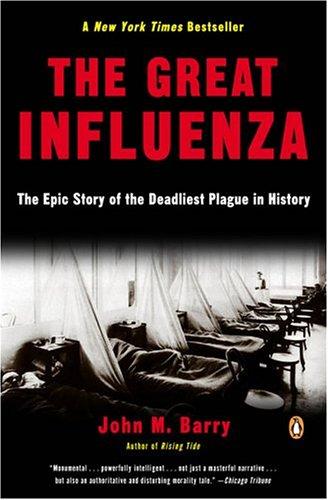
The Great Influenza by John M. Barry is a fascinating look at the influenza pandemic that rocked the world in 1918. This terrifying virus killed between 3-6% of the world’s population between June 1918 and December 1920, and infected almost 30%. It is a history book, but it is heavy in the science. It is a thoroughly detailed book, providing information and statistics from around the globe during the outbreak, although the book gives the most time to those in the United States.
The perspective of The Great Influenza is primarily one of American citizens and cities and American scientists and doctors. It is set in the backdrop of the country’s transition to “modern medicine” from the period of home remedies and folk cures. A large portion of the early book is focused on laying a foundation for the tale of the pandemic by giving a detailed look at American medical history. I found this section of the book interesting and enjoyed the overlap it had with several books I’d recently read from the same time period, but I can see how one might find it extraneous to the story.
Once you are past the more dry sections of the book, The Great Influenza reads very much like a suspense thriller – because it was. Pandemics are already scary by nature, and this book is no help to that fear. There are so many levels of concern: From the nature of the lethal virus itself, to the reactions of the politicians who were more worried about worrying people than saving them, to the total ineffectiveness of most measures taken to stop the spread. The result is fascinating, but chilling.
The book also contained a lot of information that people might not have been aware of. Just as an example, I always remember being told that the reason the virus killed so many healthy young adults was because it was primarily confined to the military populations for the Great War. I’m sure others have heard similar things. While it is true that the War greatly aggravated the spread on many fronts, a major reason why so many young and healthy died is because the virus causes something called cytokine storm which is an overreaction of the immune system. For this reason, the people with the healthiest immune systems often ended up facing the most lethal symptoms, as their systems went into overdrive and killed them.
The rest of the book is devoted to the scientists and doctors who dedicated their lives during the pandemic to its cause. Discovering the nature of the virus, its causes, how it was spread, why it was so deadly, and how to stop it was a unifying goal for many of these people. The Great Influenza tells their individual and collective stories, and discusses the work they did and any insight they were able to shine on the pandemic that was devastating the world. The book is not just about how the flu impacted the world, but how the world impacted the flu.
Overall, the book is extremely well-researched and covers a huge scope of history, politics, and medical science for many decades. It is apparent that Barry put in a tireless effort to provide us with a thorough and informative book. It is absolutely worth reading not just for the story of the 1918 influenza, but also because of the illumination it provides on how the world should (and shouldn’t) handle future pandemics.
On Amazon.com: Kindle
or in Paperback
.
Tags: 1918, American, government, h1n1, historical, influenza, John M. Barry, medicine, outbreak, pandemic, science, science history, science research, spanish flu, the Great War, viral, virus, WWI
Posted in American History, Biological Science, History, History of Science, Medical Science, Military / Warfare, Modern History, Political, Science | No Comments »
October 31st, 2011
My intense fondness for the HBO Original Series The Wire inspired me to pick up the book Homicide: A Year on the Killing Streets by David Simon. Although Homicide more directly influenced the NBC show of the same name (which admittedly I’ve never seen), it is what started Simon down the path that eventually resulted in the creation of my favourite TV series. As the head writer for The Wire, it seemed reasonable I would enjoy his first book on the real life Baltimore homicide detectives.
Unlike most other ‘true crime’ type books, Homicide does not follow one single case, one particular murder or killer. In fact, the book is not even really about the crime itself, although that provides a foundation for the contents. What Simon has given us is a special window to the detectives themselves, both as individuals and as a department. It’s about how they work, from the crime scene to the interrogation, their uniquely dark sense of humour, the politics of the homicide unit, socially and more literally. It’s a great angle, and one that makes the book feel unique in a genre where it could be lost in a sea of thousands of similar books.
To write the book, Simon shadowed city homicide detectives for a year; the book is completely non-fiction unlike the shows that resulted from it. We get clear accounts from the police desks, to the streets, to the interrogation rooms, to the courtroom. The detectives are real, the cases are real, the dialogue is honest quotes. Some of the cases are solved during the book, but many of them remain open even today, a sad reflection of the realism of the book. Although old enough now to assume that much of the information within is antiquated, I still felt it was an insightful look into the job.
I found myself recounting some of the stories to other people. One of the more interesting stories from the book is what Simon writes about after he finished his work with the Baltimore police when a new policy was instituted forcing department transfers every few years under the guise of preventing boredom. This change not only dismantled the homicide unit (and surely other good teams within the police force) but also destroyed one of the finest tools a homicide detective uses to solve cases: experience. Baltimore’s crime rate was already high and rising with drug-related violence, but had previously had a case clearance rate better than the national average. After this change, the amount of cases successfully solved decreased drastically. It was a very sad discovery to hear in light of Baltimore’s infamy for having a terrible homicide rate.
Simon has a great writing style that really draws the reader in so they feel like they are standing alongside the men as they read. It’s dark and — to use a cliche — gritty, but very engaging and always interesting. The personalities and backgrounds of the detectives themselves are described in detail, but never boring or overdone. People normally adverse to non-fiction will probably enjoy that despite the fact the book does not have a singular “plot” to it, it reads very much like a novel. It has lots of dialogue, is full of amusing anecdotes, and the homicide cases Simon chooses to highlight are all very fascinating ones that could be told stand alone. Fans of The Wire will appreciate recognising stories and characters that were fictionalised in the show, but someone who has never watched it will not feel as if they have missed out.
Homicide is a great read for anyone interested in reading about the police force, how murder cases are worked, for fans of either TV show, people who love reading True Crime, or people who just wanted to read about Baltimore’s struggle against violence.
On Amazon.com: in Paperback
or Kindle
.
Tags: Baltimore, crime, David Simon, drugs, Ed Burns, Homicide, homicide detectives, Homicide: A Year on the Killing Streets, Homicide: Life on the Streets, murder, police, The Wire
Posted in Crime, Political | No Comments »
September 14th, 2011
Bonk: The Curious Coupling of Science and Sex by Mary Roach is typical of her other books: it’s full of fun, interesting science, and is a little bit of crazy and a lot of hilarity. Having already traveled to the morgue and outer space with Roach, I was more than enthusiastic to follow her into the bedroom.
The book is, obviously, about sex. You will read about genitals and toys and the author having, ahem, relations in an MRI. If that makes you blush, you probably might want to avoid this book. Or, better yet, put another dust jacket on it and read it anyway.
A quick read, Bonk covers a lot of topics but none of them go particularly in-depth. The organisation is more thematic than topic-based, so you might find your anatomy lesson spread out through several chapters rather than all consolidated into a single “About: Genitals” chapter (for my purposes, I’ll cover things more topically). The book doesn’t cover much in the way of sexuality — although it’s obviously relevant and still discussed — it’s more about the act itself.
Being a book focused on the science of sex, the bulk of the book is really about research into the field. We get a lot about the people who really started it all – famous names like the Masters & Johnson partnership and Alfred Kinsey. These researchers not only paved the way for current studies but also provide plenty of weird or amusing anecdotes as a result of being the first to do things in a time when it wasn’t an acceptable area of study.
In addition to learning about research of the past, the studies and tools used now are investigated as well. Roach paints a very enlightening picture of what kind of sex research occurs today and how it’s done. Think internal cameras and imaging machines and all other sorts of awkward means of measurement. Roach interviews people who participant in these studies, as well as taking part in several herself.
Roach of course covers the basic stuff, always clever and peppered with funny stories. The anatomy and the biology behind sex: genitals, hormones, fertility. We get some psychology, gender issues, sexuality as well. She discusses masturbation and sex toys and practices.
Sexual impotence and dysfunction is also a theme within the book. The book also covers sex for people suffering physical handicaps like paralysis. You will read about cutting edge (and eye-widening) surgeries, implants and the doctors that do them, and the doctors who innovate and perform these procedures and the people that get them. You’ll also learn about other wacky ways things things are approached – now and in the past.
The book has plenty of funny, relevant stories, as well. You’ll read about the guy who implanted suckers with goat testicles to increase fertility (the subject of another book I just read, in fact), about pig orgasms, sex monkeys, impotence court trials and porn star crotch licenses. Additionally, Roach uses a ton of footnotes, which are often as good at the text itself – don’t skip them!
While Bonk is not my favourite book of hers — Stiff still holds this title — it is not because this book is lacking so much as the others set a very high bar. It’s a great read and you’ll come away a little more informed and a little more amused.
On Amazon: Paperback and Kindle
Tags: Alfred Kinsey, anatomy, fertility, gender issues, hormones, impotence, Mary Roach, Masters & Johnson, medicine, porn star, psychology, science, science history, scientific research, scientist, sex, sexual dysfunction, sexuality, sociology
Posted in "PopSci", Biological Science, History of Science, Medical Science, Pop Culture, Science | No Comments »
August 4th, 2011
Of the dozens of books I’ve read this year, The Disappearing Spoon: And Other True Tales of Madness, Love, and the History of the World from the Periodic Table of the Elements by Sam Kean is my easily my favourite. It was very fun to read, accessible, and written with a refreshing cleverness that was just the right balance of information and fun. It would be an understatement to say I learned a lot and not hyperbole to say I had a great time doing it.
At it’s core, The Disappearing Spoon is a science history book about chemistry, the periodic table. It feels terribly unfair to reduce the book to something that sounds so dry, but there it is.
Keans introduces us to every element on the periodic table. The goal is obviously to get us to appreciate every single one, so he emphasises what makes it special or interesting. Sometimes we learn how or where it was discovered or by whom, but sometimes it focuses entirely on why it is unique and what it can do. If that element made an impact on our world, physically, culturally, economically… we learn how and why, and we learn to love it in the same way the author does.
The book is not consistent with what we learn for every element — some things get multiple pages while others just a short blurb — but that’s okay because we’re getting the fascinating stuff. Most of the elements get their own time in the spotlight, while a few are discussed along with their close chemical relatives.
This is a hard book to write about without writing too much or too little. It’s hard to choose a few highlights to share without neglecting things that probably deserve attention. But if you want to learn about Tycho Brahe’s prosthetic nose, or how silicon revolutionised computers, about crazy poisons or wild drugs, explosions, Fauste, weapon technology, black holes, people turning blue, homemade nuclear reactors, why Americans drop the ‘i’ from ‘aluminium’, other bizarre stories, this book will have something for you.
I’ve already found myself repeating the amusing anecdotes or information from the book to people. Twice I insisted on reading a passage to someone I know would appreciate a tale within. For a book that is intended to be very limited in scope, you will learn about so much beyond the periodic table. I was just so excited about it that it was impossible not to want to share things; this book will boost your trivia knowledge, but it also might make you the obnoxious know-it-all at parties.
To my chagrin, I was unenthusiastic about reading The Disappearing Spoon initially since a book about the periodic table doesn’t exactly sound like a rip-roaring adventure. Even when I did finally order it, it sat around on my Kindle for six months before I finally gave it a go. It makes me a little sad to admit that if so many people hadn’t raved about it, I never would have read it at all. I am so glad I gave this book a chance, and I hope you will too.
On Amazon: Paperback | Hardback | Kindle
Tags: chemist, chemistry, element, Perl, Sam Kean, science, science history, scientist
Posted in "PopSci", Chemistry, History, History of Science, Science | No Comments »
June 15th, 2011
The following are some impressive books on colonial and post-colonial Africa that I want to give a nod to. Eventually, I may reread the books so I can write the full reviews they deserve but in the meantime I will give them a few words here.
I recommend these phenomenal books with caution and a heavy heart. The following is not light reading. Africa under colonial rule was a very brutal place and today many of the nations emerging from under colonial rule are volatile and steeped in tragedy. Entire governments rise and fall, and stories of wars, rebellions and coups litter our world news, and we hear of genoicide, ethnic cleansing, and other government-sanctioned atrocities. It should be obvious that the following books are not cheerful books. They can be difficult to read. However, I believe it’s important to be aware of these horrors and their causes, because these events are not from the distance past, they have occurred in our lifetime and are still happening. Books like these serve a very critical role in our conscience.
With that out of the way:
Shake Hands With The Devil: The Failure of Humanity in Rwanda by Roméo Dallaire
Lieutenant-General Dallaire wrote this book to record his experiences as head of the UN peacekeeping team sent to Rwanda in 1993/94 following Rwanda’s civil war, during the Rwandan Genocide. On the political front, the book gives an insightful look into the events that caused and contributed to these terrible events, and an informative look at all the major players in the unfolding drama. Dallaire slams the ineffectiveness of the UN in Rwanda and all the nations who turned a blind-eye when they had the power to step in and stop the killing of hundreds of thousands but didn’t. The book chronicles not just the events that occurred, but also his personal emotional difficulties as he stood helpless while surrounded by unimaginable atrocities.
This book on Amazon.com

The Devil Came On Horseback: Bearing Witness to the Genocide in Darfur by Brian Steidle
This book focuses on the Darfur situation in Sudan, from the perspective of a former Marine working for the African Union. Steidle’s job was to document and monitor conflicts between the warring Sudanese factions and the government (supposedly under a cease fire agreement). He witnessed many horrible events, often with sufficient evidence to suggest they were supported or ordered by the government, but was forbidden to intervene, unable to do anything other than make notes and take pictures. Following his resignation, Steidle made it his mission to spread the word about the situation in Darfur, going before governments, the UN, doing speaking engagements throughout the world and working with several non-government organisations.
This book on Amazon.com

The Graves Are Not Yet Full: Race, Tribe and Power in the Heart of Africa by Bill Berkeley
This book investigates the causes behind why modern Africa has faced so much political and ethnic turmoil through close looks at Liberia, Rwanda, Congo/Zaire, Sudan and South Africa. Berkeley’s hypothesis — that the tragedies that have occurred are fabricated by the people in power as a form of control — has been controversial as simplistic, but the book is worth the well read whether you arrive at the same conclusion or not. The author does very well to support his assertions with detailed examples and persuasive arguments, leaving his premise, at minimum, thought-provoking and worth considering. The book is extremely thorough (although it does not give equal coverage to all the countries addressed), giving the reader a very clear understanding of how the atrocities in these places unfolded and developed.
This book on Amazon.com
King Leopold’s Ghost by Adam Hochschild
Venturing further into the past, this book is actually about the Congo under colonial rule by King Leopold II of Belgium, beginning with its early exploration until its exploitation under the king’s thumb. The story of the Leopold II and his use of the Congo as a tool for his greed (until it was eventually wrestled from his claws by the Belgian government) is intriguing. The book is a graphic and disturbing look at what life was like under Colonial rule and harshly criticised those who have implied otherwise (both in the past and even today). Not all depressing, the book also talks about the people who brought devoted their lives and called attention to the issues in an effort to end the terrible exploitation.
This Book on Amazon.com
We Wish To Tell You That Tomorrow We Will Be Killed Along With Our Families by Philip Gourevitch
This book takes a close look at the genocide in Rwanda. It is a different approach than that seen in Dallaire’s book, written by a journalist after the genocide and based heavily on interviews with survivors (both victim and perpetrator). It includes the story of hotel manager Paul Rusesabagina that was later made into the film Hotel Rwanda, but also the previously untold stories of many other Rwandans. It is a gruesome but valuable picture of the events, and the circumstances and political powers that caused and perpetuated such evil.
This book on Amazon.com
In The Footsteps of Mr. Kurtz by Michela Wrong
Although this book begins with coverage of the Congo as early as King Leopold II as it set the stage, the book is about Mobutu Sese Seko’s presidency over Zaire following the assassination of Patrice Lumumba. Mobutu is well known for his corruption and excesses, living in ridiculous palaces and pocketing billions of dollars in foreign money while his country — rich in resources — lived in stunning poverty, death & disease and in terror of its government. The book is an intriguing look at Mobutu as a man and a leader, and how he was able to pull off such shocking things. For all his flaws and evils, Mobutu was charismatic, a keen politician and absolutely fascinating. Wrong attempts to make sense of why such a man was able to utterly destroy his own people and country over the course of decades while simultaneously being much loved (and financed!) by the West.
This book on Amazon.com

The first three books were also made into documentaries. I have seen both Shakes Hands With the Devil and Devil Came on Horseback; both were very good but inferior to their written counterparts. Shake Hands was much more personal, focusing heavily on the psychological impact on Dallaire. Devil Came on Horseback was solid but felt abridged compared to the book. I have not seen the film King Leopold’s Ghost.
* On a final note, I want to add a disclaimer. My use of any positive adjectives to describe these books refers to the writing style, the readability, and the insightfulness of the information contained within. It is dangerous ground to call a book about genocide “wonderful” and I have tried to carefully word my praise for the books to not sound callous.
Tags: Adam Hochschild, apartheid, Arusha Accords, Augustin Bizimungu, Belgium, Bill Berkeley, Brian Steidle, Charles Taylor, child soldiers, civil war, colonial rulers, colonialism, Congo, Congo Free State, Darfur, Democratic Republic of Congo, ethnic cleansing, European colonialism, foreign intervention, foreign policy, genocide, government, Heart of Darkness, Henry Morton Stanley, Hotel Rwanda, Hutu, Impuzamugambi, Interahamwe, International Criminal Tribunal for Rwanda, Janjaweed, Joseph Conrad, Joseph Desire Mobutu, Joseph Mobutu, Justice and Equality Movement, Juvénal Habyarimana, King Leopold II, Kwame Nkrumah, Liberia, Ludo De Witte, Michela Wrong, Mobutu Sese Seko, National Patriotic Front of Liberia, Patrice Lumumba, Paul Rusesabagina, peacekeeping, Philip Gourevitch, Revolutionary United Front, Roméo Dallaire, Rwanda, Rwandan Armed Forces, Rwandan genocide, Rwandan Patriotic Front, Sierra Leone, South Africa, Sudan, Sudan Liberation Movement, The Leopard, Théoneste Bagosora, Tusti, UN, US intervention, warlord, Zaire
Posted in Africa, Cultural Studies, History, Military / Warfare, Modern History, Political | No Comments »